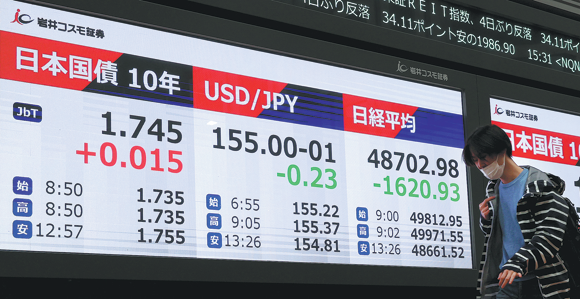
A financial data board in Tokyo shows Japan's benchmark Nikkei 225 index closing at 48,702.98 on Tuesday, down 1,620.93 points from the previous trading day. THE YOMIURI SHIMBUN/AP IMAGES
At a meeting between foreign ministry officials of China and Japan on Tuesday, Beijing called for Tokyo to "stop making trouble on issues related to China and correct its mistake with concrete actions", and once again asked for a retraction of Japanese Prime Minister Sanae Takaichi's provocative comments on Taiwan.
Liu Jinsong, director-general of the Chinese Foreign Ministry's Department of Asian Affairs, held consultations in Beijing with Masaaki Kanai, head of the Japanese Foreign Ministry's Asian and Oceanian Affairs Bureau.
On Nov 7, Takaichi became the first incumbent Japanese prime minister to publicly suggest in Japan's parliament the possibility of Japanese military intervention in Taiwan.
According to Foreign Ministry spokeswoman Mao Ning, the Chinese side pointed out at Tuesday's talks that Takaichi's absurd claims gravely violate international law and the fundamental norms of international relations, severely damage the postwar international order, and blatantly betray the one-China principle and the spirit of the four China-Japan political documents.
Takaichi's remarks "fundamentally damage the political foundation of China-Japan ties, are extremely malicious in nature and impact, and have spurred fury and condemnation among the Chinese people", Mao said.
With reports in some media saying that the bilateral ties are falling to a record low, Mao said the root cause is Takaichi's comments on Taiwan, and "China's stance on safeguarding its core interests and upholding international justice remains unchanged".
"Japan must retract its erroneous remarks, repent and change course, offering a clear and satisfactory answer to the Chinese people," she added.
Observers said the signal sent by Beijing is that Japan's refusal to withdraw Takaichi's remarks is an attempt to gloss it over and will only perpetuate the ongoing tension.
Lyu Yaodong, a research fellow at the Chinese Academy of Social Sciences' Institute of Japanese Studies, said, "Japan should reconsider and think twice about whether it serves its fundamental national interests to sacrifice its overall relations with China."
"Tokyo is seeking benefits from two approaches at the same time: gaining economic profits in its relations with China while making trouble and political provocations one after another. We should not let this happen," he added.
Liu Jiangyong, a professor of Japanese studies at Tsinghua University, said that Japan is the only country in the world that has exercised colonial rule over China's Taiwan province for 50 years, and that some right-wing anti-China politicians in Japan, such as Takaichi, have shown little reflection on the history of colonial rule.
"Takaichi's remarks were not a slip of the tongue or just her personal views. The words actually revealed the die-hard beliefs and strategic plans of Japan's right-wing anti-China forces," he added.
Recently, some Japanese officials confirmed that the government has planned a far-reaching reform to revert the ranks of Japan's Self-Defense Forces to the names used by the prewar Imperial Japanese Army.
The plan triggered widespread criticism by Japan's Asian neighbors, as it is seen as betraying the Self-Defense Forces' long-lasting tradition of downplaying war-related features and reminds the people of countries invaded by Japan of the atrocities and painful memories of more than 80 years ago.
In response to the rank-reverting plan, Mao, the Foreign Ministry spokeswoman, said Japan's right-wing forces are "sparing no efforts" to remove restraints imposed by the country's pacifist Constitution, and are advancing military expansion and buildup.
She blasted Tokyo's drive in recent years to revise security policies and lift limits on weapons exports, and its plan to abolish Japan's Three Non-Nuclear Principles — not possessing and not producing nuclear weapons, and not allowing introduction of nuclear weapons into Japanese territory.
"Eighty years on, militarism must never be revived in Japan, the post-WWII international order must never be challenged, and world peace and stability must never be ruined again," Mao added.
外媒关注中国春节新变化:年味更浓、消费强劲、旅游更热 中新网2月18日电(魏晨曦)2024年春节是农历新年被确定为联合国假日的第一个春节,浓浓的年味,丰富的美食,消费的热潮……中国人把春节过出了新高度,中国经济的 锦绣中国年 | 天津重点监测商贸企业春节假期销售额同比增11.2% 中新网天津2月18日电 (记者 王君妍 通讯员 王 张欣悦)今年春节假期为期8天,是一个“超级假期”,消费市场火爆程度也尤盛往日。记者从天津市商务局 中新经纬2月18日电(李晓萱)打扰一下,龙年开工第一天,你领到老板发的红包了吗? 微信推出面对面红包 据微信官方18日消息称,微信推出了“面对面红包”。具体内容如下: 新年开工,一声:“老板,新年好!”道出了多少期 灯会,是中国古老的民俗文化。今年春节各地的灯会体现着传统文化的创新演绎,点亮了国内外多个城市。“中国风”的灯会与海外文化相互交融,广受海外游客喜爱。随着正月十五元宵佳节的脚步渐近,中国 吃不完,根本吃不完!已经是年后的第三个工作日了。从全国各地陆续返回工位的人们,依然能回忆起被某种春节限定美食支配一整个假期的恐惧。“各省都有自己的噩梦”这个热搜年前就火了,但只有经历过“每 中国考古,在许多外国人甚至中国人看来,一度非常神秘。近日记者在与中国考古学家的交流中了解到,从考古技术发展、到公众考古创新,再到中外考古交流,中国正不断构建具有中国特色、中国风格、中国气派的考古 。本文链接:Japan slammed for troublemakinghttp://www.sushuapos.com/show-5-78018-0.html
声明:本网站为非营利性网站,本网页内容由互联网博主自发贡献,不代表本站观点,本站不承担任何法律责任。天上不会到馅饼,请大家谨防诈骗!若有侵权等问题请及时与本网联系,我们将在第一时间删除处理。